The Alchemy of Genetics
Basic Genetics of Silver and Golden Persians
Updated: February 22. 2024Feline genetic specialists are always discovering new things in regards to the colors Silver and Golden (especially Golden) and what is written as cutting edge developments today, may not be accepted tomorrow. As I learn new genetic concepts and think of better ways to explain things, the information on this page will be updated. Research everything. Never stop learning.
As you read through this material, you may ask yourself "Do I really need to know this stuff?" The answer is "Yes, you do" if you breed silver and goldens, If you are going to breed cats for any length of time, you need to have a basic understanding of what you are doing from a genetic standpoint. You need to establish a breeding program based on both short term and long term goals built with a solid foundation of knowledge. You don't need to remember all the details but you will be expected to understand the basics. So grab a sandwich, sit back and absorb as much information as you can. What doesn't kill you, will make you smarter than most.
Two words you will need to know to continue:
genotype: what a cat is genetically - the "blueprint" from which a cat is created
phenotype: what a cat is like on the outside - the stuff you can see with your eyes and feel with your hands
Basic Eye Color Genetics
for Silver and Golden Persians
Content and images by Jayne Wood, Alchemist Persians
The Basics
One of the remarkable features of cats is the variation of eye color that is inherited independently of coat color. The term eye color refers to the color of the iris. The normal variation in iris color is quite wide, ranging from copper, through shades of yellow and hazel to green and blue-green. The brown and dilute genes (b and d) influence pigmentation of the eye, but it seems that the normal variability is due to polygenes and chance which tend to over-ride the effect of the major genes for eye color.
The influence of polygenes means that, within reason, selective breeding can stabilize any desirable eye color. In practice, it is easier to 'fix' extreme shades (such as copper or green) than intermediate ones. An exception to this is the blue eye color of the Siamese and various white breeds which is definitely associated with major genes.
The main eye colors for cats are: copper, yellow, hazel, green, blue (as with dominant white), and blue (as in Siamese). For now, let's concentrate on Silver and Golden Persian eye color. The CFA Show Standard clearly states the required eye color of Silvers and Goldens: "Eye color: green or blue-green. Disqualify for incorrect eye color being copper, yellow, gold, amber, or any color other than green or blue-green." Deeper shades of green are preferred over lighter ones. Blue-green and emerald are the most sought after colors because of their rarity and striking beauty while olive and yellow-green eyes are avoided.
Silver Tabbies, can have either copper, green, or hazel eyes.
Click here for The genetics of Silver Tabby Persians
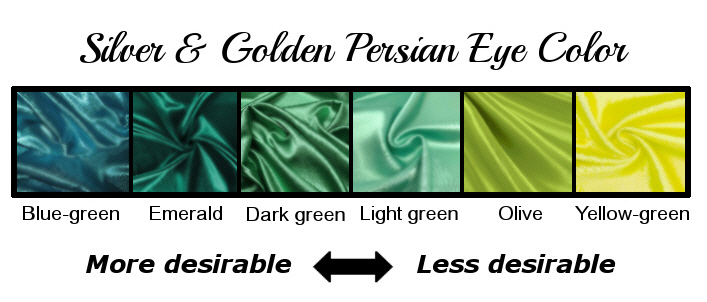
The eye color in Silvers and Goldens can change over time and even fade as they age. When young, all kitten's have blue eyes. But with close inspection when Silver and Golden Persians are about 8 weeks old, you can see the promise of them starting to turn green. The longer they st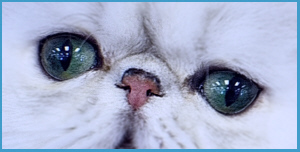 ay blue and the brighter the blue, the better the color will be. If you look closely and see tiny flecks of purple in the iris, this is an indication of really good eye color to come. All of the cats in my breeding program have had their eye color completely developed when they reached a year old and are either dark green or emerald with some leaning towards blue-green. This was accomplished by carefully selecting kittens that showed the most promise for good eye color and keeping them for the breeding program in hopes of making the eye color of future kittens more predictable and of the most desirable shades of green. But mostly, it was good luck. (image: GC Alchemist Little Bit O'Magic) ay blue and the brighter the blue, the better the color will be. If you look closely and see tiny flecks of purple in the iris, this is an indication of really good eye color to come. All of the cats in my breeding program have had their eye color completely developed when they reached a year old and are either dark green or emerald with some leaning towards blue-green. This was accomplished by carefully selecting kittens that showed the most promise for good eye color and keeping them for the breeding program in hopes of making the eye color of future kittens more predictable and of the most desirable shades of green. But mostly, it was good luck. (image: GC Alchemist Little Bit O'Magic)
Basic Coat Color Genetics
of Silver and Golden Persians
Content and images by Jayne Wood, Alchemist Persians
The information and images on this page are property of the author and this website. If you use any of the content or images on this page on another website, you must give reference to this site and the author.
The Main Color Genes of Silver and Golden Persians
| A |
Agouti - ground-color of tabby; hairs banded grayish yellow/orange |
| aa |
Non-agouti |
| B |
Black pigment (black/brown) |
| D |
Dense pigmentation |
| I |
Inhibitor - responsible for suppression of pigment in the hair shaft |
| ii |
Normal (full development) pigmentation |
| Wb |
Wide band |
The Basics
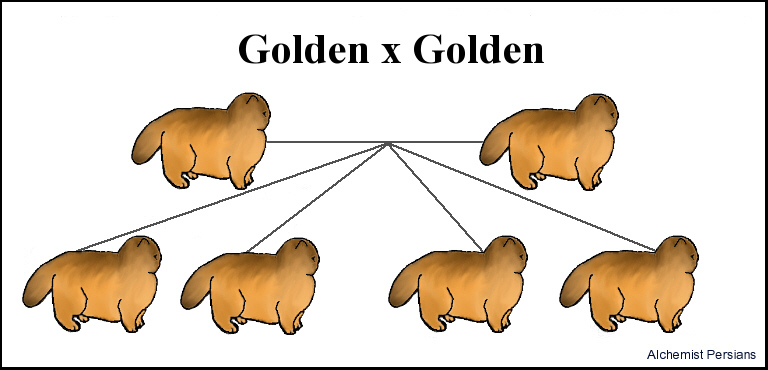
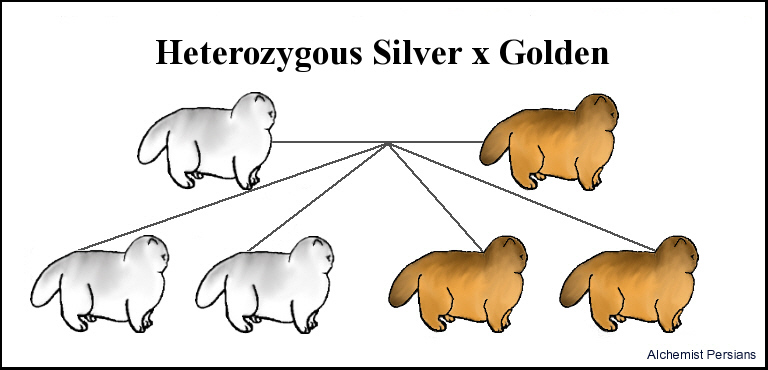
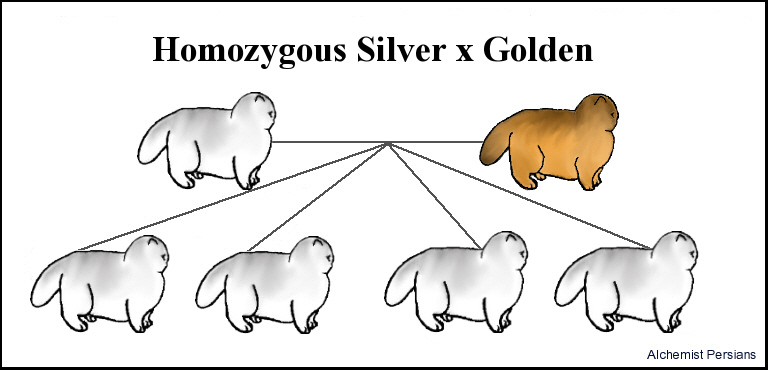
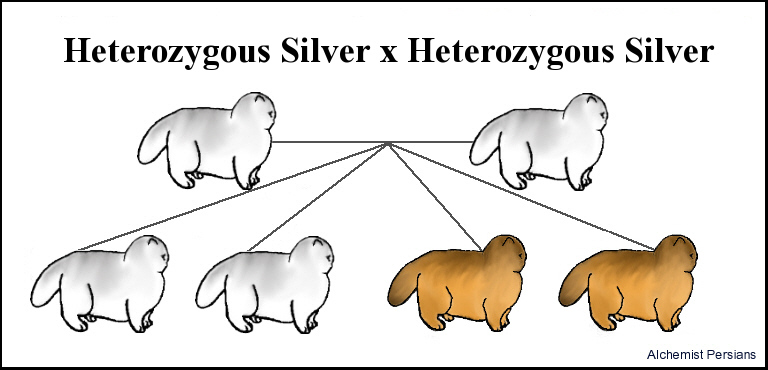
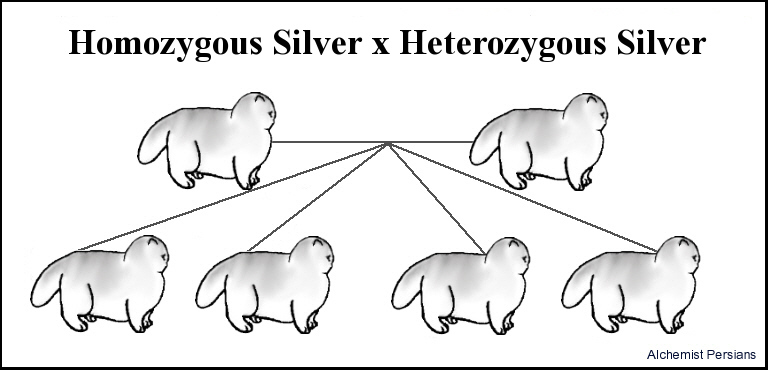
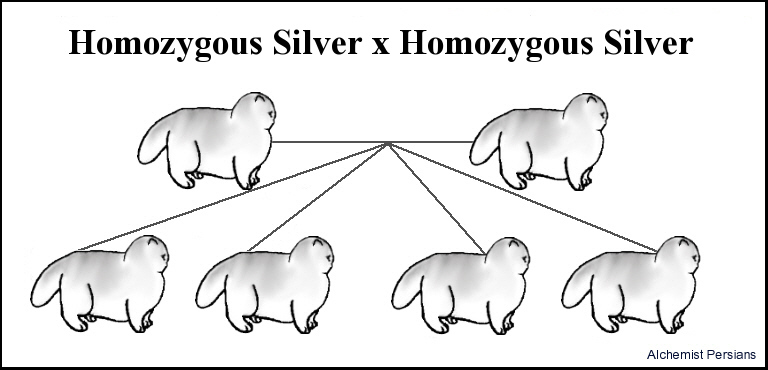
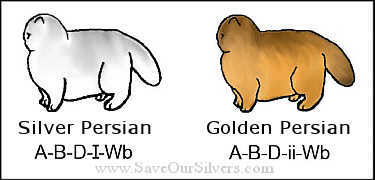
There have been several theories surrounding the genetic make-up of Golden Persians over the years and due to new genetic research, they have either been proven to be inaccurate or have been expanded upon to increase their accuracy. There are still many unknowns in color genetics and research is still ongoing; especially in regards to Goldens. The once mysterious genetics of Golden Persians can (for now at least) be explained in simple terms: The difference between Silver and Golden Persians is the inhibitor gene (I). This gene is dominate and can not be carried recessively. The only colors of cats that possess the inhibitor gene are Smokes (aa-B-D-I), Silver Tabbies (A-B-D-C-I-T) and Silvers (A-B-D-I-Wb). Goldens (A-B-D-ii-Wb) occur when two heterozygous (non-dominate) Silvers or one heterozygous Silver and one Golden are mated creating the possibility for the offspring to not pick up the inhibitor gene. When two Goldens are mated, the only results possible are Golden, Golden Tabby, or Brown Tabby (depending on how many modifying genes are present) since the inhibitor gene was not present in either parent.
How we see objects: When light shines on a cat's coat, for instance, the hair absorbs only some of the light and reflects the rest. Which wavelengths are reflected or absorbed depends on the properties of the hair.
Black Pigment (B)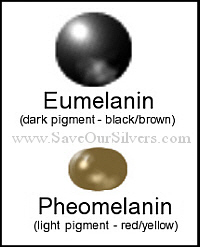
Melanin is a microscopic color protein granule that is deposited in the hair shaft which, due to the modifiers present, can vary in size and arrangement; this gives variations in color and pattern. Melanin comes in two forms: dark, round black/brown color granules (B) (eumelanin), and light, elongated red/yellow color granules (O) (pheomelanin). Although there are both types of color granules in the hair shaft, they are in varying levels. A black cat, for instance, has an abundance of eumelanin granules but only trace amounts of pheomelanin.
Several modifying genes can cause variation in the density of the melanin granules, so other colors can be produced; the most variation is found in the black-based (eumelanistic) colors. Black granules are distributed in various ways to produce brownish colors that range from gold and cinnamon to chocolate, which are all variations of black.
Dense Pigmentation (D)
The dominate dense pigmentation gene (D) allows for the complete expression of pigment. The recessive expression of this gene (dd) represents dilute (blue) pigmentation as in Blue Silvers and Blue Goldens.
The agouti gene (A)
The agouti gene (A) determines the distribution of pigment in the hair. In eumelanistcally-pigmented black hair shafts (B), the agouti band is normally a drab grayish yellow/orange color with a brindled appearance that is caused by a band of yellow on the otherwise dark hair shaft. However, the color of the (A) agouti band can be a richer orange due to the effect of polygenetic rufousing factors. The rufous factor is not a single gene, but a whole series of genes that can intensify or lighten red tones.
The agouti band in eumelanistic (black-based) colors, marks the period where the production of melanin has slowed down. The granules in the hair shaft have been "shredded" which gives them a yellow to orange color as they reflect light in various shades of brown. In the non-agouti solid black cat, the yellow band is absent, so there is solid dark pigment throughout the hair shaft.
The Inhibitor Gene (I)
The inhibitor gene (I), inhibits the placement of color granules along the hair shaft; therefore, color will only appear at the tip of the hair. This leaves the base of the hair void of color (i.e. translucent, appearing to be white). The amount of translucence in the hair shaft depends on other genes (agouti and wide band) working in tandem with the inhibitor gene. In some cases a break-though of the pheomelanin (yellow/red) occurs. This suggests that perhaps while the inhibitor gene is dominant, there is a limit to the amount of pheomelanin it can suppress. The result is a small amount of pheomelanin pigment showing in isolated areas resulting in an undesirable color break in the otherwise translucent hair shaft called tarnish.
Wide Band (Wb)
Along with the agouti gene (A), the wide band gene (Wb) plays an important role in the color of the Silver and Golden Persian. The wider the band, the less color there will be at the end of the hair shaft.
Genetics of the Golden Persian - A-B-D-ii-Wb
The agouti (A) gray/yellow/orange coloring is what gives Goldens their unique base color. The absence of the 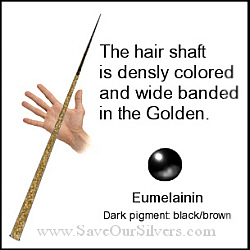 inhibitor gene (ii), and the presence of the wide banding gene (Wb) with the dense pigmentation gene (D), allows for the black color granules (B) to be spread throughout the hair shaft reflecting a golden hue. The hair shaft of a Golden appears to be tipped in black but in reality, the hair is "smeared" or "streaked" with black color granules. It is the agouti gene that makes the hair shaft appear to be tipped. Through selective breeding practices, more or less shading can be achieved for Goldens as well as the base color of gold. inhibitor gene (ii), and the presence of the wide banding gene (Wb) with the dense pigmentation gene (D), allows for the black color granules (B) to be spread throughout the hair shaft reflecting a golden hue. The hair shaft of a Golden appears to be tipped in black but in reality, the hair is "smeared" or "streaked" with black color granules. It is the agouti gene that makes the hair shaft appear to be tipped. Through selective breeding practices, more or less shading can be achieved for Goldens as well as the base color of gold.
One of the more challenging aspects of breeding Goldens is eliminating the tabby markings. Since the inhibitor gene isn't present, an even golden hue is dependent upon the wide band gene to push the black color molecules along the hair shaft with sufficient strength to diffuse and thus eliminate the tabby markings. When successful, the tabby markings will disappear except for perhaps a few bracelets on the front legs and some faint banding on the head and tail. When the wide band gene isn't strong enough, the overall effect leaves the Golden looking like a warm brown tabby with stripes and swirls on its body and heavy pigmenting down the spine instead of the overall soft hue of gold with evenly distributed black shading.
Genetics of the Silver Persian - A-B-D-I-Wb
The agouti (A) gray/yellow/orange coloring in Silvers is suppressed by other genes. 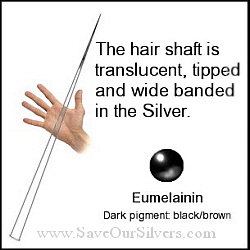 The inhibitor gene (I), and the presence of the wide banding gene (Wb) along with the dense pigmentation gene (D), allows for the black color granules (B) to be forced to the end of the hair shaft creating their sparkling, silver color. The hair shaft of a Silver is tipped with black color granules while the rest of the hair shaft is translucent or void of color making it appear to be white. It is the inhibitor and wide band genes working together that make the hair shaft tipped and free from tabby markings. Through selective breeding practices, lighter and heavier amounts of tipping can be produced for Silvers resulting in shaded and chinchilla varieties. The inhibitor gene (I), and the presence of the wide banding gene (Wb) along with the dense pigmentation gene (D), allows for the black color granules (B) to be forced to the end of the hair shaft creating their sparkling, silver color. The hair shaft of a Silver is tipped with black color granules while the rest of the hair shaft is translucent or void of color making it appear to be white. It is the inhibitor and wide band genes working together that make the hair shaft tipped and free from tabby markings. Through selective breeding practices, lighter and heavier amounts of tipping can be produced for Silvers resulting in shaded and chinchilla varieties.
True Goldens are only produced from Silver and Golden matings. Offspring from other matings will generally more closely resemble brown tabbies.
Creating New Bloodlines
Black Smokes and Silver Tabbies are a logical way to create new Silver and Golden bloodlines since they are the only other cats that have the inhibitor gene. However, solid Blacks can also be a good choice. Genetic possibilities are not probabilities. Much depends on whether the cats are heterozygous for homozygous for certain traits.
- Mating Silver x Black Smoke can produce Silver, Silver Tabby, Black Smoke or Solid Black offspring. However, the resulting Black Smoke offspring will likely have some tabby markings.
- Mating Golden x Black Smoke can result in Silver offspring because the Golden provides all of the modifiers needed; the only thing lacking is the inhibitor gene which is provided by the Black Smoke. However, some of the wide banding modifiers may be lost in this mating resulting in heavier tipping or tabby markings.
- Mating Silver x Solid Black is another way to create a new bloodline because the Silver brings the required genetic foundation. However, it may take several generations to reduce the correct amount of tipping, remove tabby markings, and correct the eye color.
- Mating Golden x Solid Black will most likely only produce Brown Tabby or Solid Black offspring since there neither parent has the inhibitor gene.
- Mating Silver Tabby x Silver will most likely produce Silver Tabby and Silver offspring although the resulting Silvers may have light tabby markings and incorrect eye color to be corrected in future generations - but maybe not!
Stating the Obvious
Careful examination of a Golden proves these cats are not tipped in black; their legs, for instance, are reversed in color (base color of hair shaft is black/gray and the ends of the hair are gold). In a tipped cat, because of the influence of the inhibitor gene, every hair is translucent and tipped with color. The inhibitor gene (responsible for tipping) does not allow for a colored base. With Goldens, the hairs have a gold hue due to the agouti gene and the wide banding gene makes the ends of the hair shaft black.
The most important thing to remember is that the color granules in a Golden are black and they remain the same in structure as in Silvers - only their distribution and modification changes to reflect light in a way that allows them to appear gold.
If I breed this cat to that cat, what will I get?
Genetics of Whites and Smokes
The information and picture in the following sections were taken from The Book of the Cat, published by Summit Books, copyright 1980. If you use this information on another website or on social media, you are required to give reference to the book. This book is no longer in print but used copies can be found on Amazon and eBay.
The Main Genes of White Persians
Let's start with the simple stuff: White Persians. First of all, there is no such thing as a white cat; I told you it was simple. What you see when you look at a White cat, is a cat of color wearing a white sweater. What lies beneath that fluffy white exterior is a color shrouded in mystery. With careful study of a pedigree, the underlying color can be fairly accurately revealed but you do need to have a basic understanding of color genetics (see chart at bottom of this page). Even then you may not be absolutely positive but a test breeding can be done to further clarify the suspicions.
Many white kittens are born with a "clarity" spot on top of their heads and careful examination of this spot can reveal the color beneath that lovely white sweater. These "clarity" spots disappear after a few months and the cat will be completely white with no telltale sign of the color secret it holds within.
There are dominant or homozygous Whites (WW) and non-dominate or heterozygous Whites (Ww). White is not carried recessively; at least one parent must be White to produce white kittens. Therefore, non-white kittens resulting from a white parent will not ever produce white kittens. BTW - You cannot breed a White cat to a color cat and get bi-color kittens unless the white cat is masking bi-color. Bi-dolor cats have the "piepald" or spotting gene (Ss and SS). But I digress; back to our white cats:
-
If a homozygous white cat mates, all offspring will be white. If two homozygous white cats mate, all offspring will be homozygous white. If a homozygous white cat mates with a heterozygous white cat, there will be both homozygous white and heterozygous white offspring in a 1:1 ratio. If a homozygous white cat mates with a homozygous non-white cat, all offspring will be heterozygous white.
- If two heterozygous white cats mate, there will be homozygous white, heterozygous white, and homozygous non-white offspring in a ratio of 1:2:1. The ratio of white to non-white offspring is 3:1. If a heterozygous white cat mates with a homozygous non-white cat, there will be both heterozygous white and homozygous non-white offspring in a 1:1 ratio.
- If two homozygous non-white cats mate, all offspring will be homozygous non-white. Homozygous non-white cats are therefore true-breeding for non-white when co-bred.
The Basic Genetics of Smokes
The Main Genes of Smoke Persians
A = Agouti and is the ground-color of tabby; hairs banded yellow/orange
a = Non-agouti and is hair that is not banded; uni-colored (acts only on black/brown)
B = Black pigment
b = Brown (chocolate or chestnut) pigment
C = full-color, or maximum pigmentation
D = Dense pigmentation
d = Dilute pigmentation (eg: black to blue)
I = Inhibitor gene. Suppresses pigmentation from hair shaft
i = Normal pigmentation. Full development of pigmentation
O = Orange, or all pigment turned to yellow/orange
o = Normal pigmentation (not orange)
The hairs in smoke Persians are tipped with color. The depth of the tipping distinguishes a cat as either shell, shaded, or smoke. A Shell has the lightest tipping and is recognized by CFA in only two colors which are red (Shell Cameo) and tortoiseshell (Shell Tortie). The next darkest color is the Shaded group and again only the reds and torties are recognized by CFA (Shaded Cameo and Shaded Tortie). The darkest in the group are the Smokes with most of the hair being colored. Smokes are recognized by CFA in all colors which include black, red, blue, cream, blue/cream, and tortie. Smokes are the most common coloring while the shaded and shell are more rare. Smokes are also being bred with bi-colors to produce bi-colored smokes (bi-colors are those cats with the spotting gene that produce cats with patches of white such as the calico).
Genotypes of tipped colors
aa-B-D-I- = Black Smoke
aa-B-ddI- = Blue Smoke
D-I-O(O) = Shell Cameo, Shaded Cameo, Smoke Cameo (Red Smoke)
dd-I-OO = Cream Smoke Cameo
D-I-Oo = Shaded Tortoiseshell, Smoke Tortoiseshell
dd-I-Oo = Dilute Smoke Tortiseshell (Blue/Cream Smoke)
As a note of comparison, the geneotype for a solid black cat is: aa-B-C-D-. Note the only difference between a solid black cat and a black smoke is the I or Inhibitor and the C or Full color genes. The best-known smoke is the black, and it is due (as are all smokes) to the combined action of the Inhibitor gene and the non-agouti a. The I gene produces a white undercoat, but the a gene produces extra amounts of pigment. The result is profuse tipping, but modifiers can increase or decrease the tipping to the extent that some smokes are almost indistinguishable from solid colored cats and others are very pale. The long-haired smoke with just the right amount of tipping and undercoat is undoubtedly a magnificent cat.
The cameos are the red equivalent of black smokes. The result from combining the I gene with the orange O. These too are beautiful cats, possessing a white undercoat and an overlay of rich apricot to red tipping.
There are three varieties in smokes, corresponding to the three degrees of tipping. The palest is the shell cameo which has a delicate sprinkling of red tipping. Next is the shaded cameo which has a slightly darker red appearance. Darkest is the smoke cameo in which the undercoat is white and the veiling is ideally a deep, even red. As with all red cats, however, tabby marking are inherent and can be dispersed only by selective breeding. This is because the non-agouti gene is ineffective on orange pigment, and for this reason too the smoke cameo - unlike other smokes - owes its intensity of color only to polygenes and selective breeding, not to a non-agouti geneotype. When tabby markings are allowed to remain, the result is the cameo tabby, with red markings on a white background.
A very elegant series of cats are the blue smokes and cream cameos, produced by introducing the dilution gene d. These are clearly of smoke form, as shown by their white undercoat, but the tipping is now cream or blue. There is considerable variation in the cream tone, from warm cream to an exquisite pale shade that has the slightest hint of pink, due to the action of polygenes. You can also get a poor quality cream that has a flat "brown paper bag" look. This is why it is important to not only breed for "type" and personality, but breed for favorable color factors.
The dilute smokes are the least often bred colors because of the complicated color factors and most importantly, the difficulty most breeders have in determining whether a kitten is a smoke or a solid. The "clown" markings can be difficult to see because of the pale coat color (for more information on how to tell if you have a smoke or a solid kitten, see the page on determining factors).
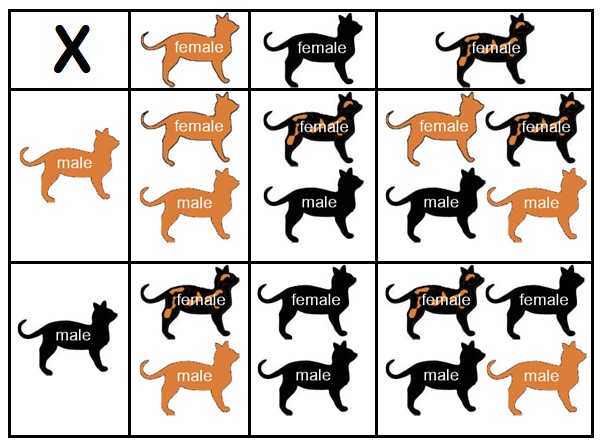
The following chart is a basic guide for combining the red and black genes. When figuring for dilutes you must take that gene into consideration as well as any dilute carriers.
Resources:
The Book of the Cat - edited by Michael Wright and Sally Walters, copyright 1980
https://www.vgl.ucdavis.edu/services/coatcolorcat.php
http://ib.berkeley.edu/courses/ib162/Week3a.htm
http://felinegenetics.missouri.edu/feline-research-projects/silver-and-golden
http://www.fanciers.com/other-faqs/color-genetics.html
http://www.rainbowsafaribengals.com/genetics101.php
Don't plagiarize. Everything on this website (photos, created images, and all information in written form) are considered property of the owner of this website unless otherwise noted. If you see something you would like to take as your own, ask permission to use it; otherwise, it is considered stealing.
Content and images property of the author of this website and Alchemist Persians
The information and images in this article are property of the author and this website. If you use any of the content or images on this page on another website or social media, you must give reference to this site and the author.
|