~ Kittens that are for sale are pictured on the "available" page ~
Sweet 6 week old silver kitten getting her first bath. No drama here!
There are a few things you should know about purchasing a kitten from me. Please read the following carefully:
All pet kittens are sold with a spay/neuter agreement. Although all of our litters are registered with CFA and you have your kitten's registration papers, you will not have the kitten's PIN number and you do not have permission to breed a cat from my lineage. Without the PIN number, you will not be able to register the offspring from your cat in any feline registration association such as CFA, TICA, or ACFA so please spay/neuter your cat as stated in your Purchase Agreement.
For your personal safety while driving home and the safety of your new pet, all kittens and cats must be securely placed in a clean, hard plastic pet carrier (of an appropriate size) before they are allowed to leave our home. No cardboard or soft-sided carriers.
I reserve the right to cancel any pending sale that I become uncomfortable with completing at any time, including the day you pick up your kitten. In the unlikely event that I cancel a sale, I will refund 100% of the deposit with an explanation of the cancellation.
If you say you are sending a deposit, do so immediately. Unless otherwise agreed upon, I only allow 3 days for your deposit to arrive to secure a kitten. If it does not arrive in a timely manner, the next person in line will take precedence.
Deposits are non-refundable and non-transferable so be sure of your decision before sending a deposit.
I will consider selling select kittens with breeding and show privileges after an interview and your references have been checked.
I do my best to provide quality pictures and videos of kittens which takes a great deal of time and effort - up to 4 hours for processing. If time permits, I take a new set of pictures before kittens go to their new homes but it is not promised. If you want extra pictures and/or videos, I'll be happy to do so for a $100 fee but only if my schedule permits.
What about shelter cats?
The purchase of a purebred cat did not sentence another cat to death and did not cause an increase in the number of shelter cats. Wanting a cat with a predictable temperament from healthy lineage did not cause a shelter cat to die not adopted.
Research and support of responsible breeders is not the problem and should not be anyone's cause of anger. Responsible breeders are not the ones who put cats in shelters. No matter the reason, the choice to support a responsible breeder did not send a shelter cat to its death. A responsible breeder health tests, temperament tests, and studies pedigrees. A responsible breeder's research can prove a cat to be worthy of being bred, only produces the number of kittens they can find homes for, and only breeds their cats to benefit the breed which is not contributing to the number of homeless cats.
The number of homeless cats in the world is a problem, but it is not a problem caused or worsened by responsible breeders. The neighbor down the street who refuses to contain their unaltered cat IS contributing to the problem. The person who impulse purchased a cat from Pet Land IS contributing to the problem. The person on Craigslist pumping out the trendiest designer mix IS contributing to the problem. The person who just HAS to let their cat have one litter "so she can experience motherhood" or because "she's just so sweet"IS contributing to the homeless cat problem.
It is understandable to be angry about the number of homeless cats in the world, but if you take a deeper look, you will find responsible breeders and people who purchase from them are just as angry about the situation and can point out at the correct causes.
~ Adapted from text by an unknown Author
How much does a kitten cost?
The first thing people want to know is price. To get my prices, you need to fill out the contact form so I know who you are - I will check to see if the information you submit is valid. Trying to beat the system will get your request deleted without consideration.
I have two prices for kittens: one for pet kittens that will be spayed/neutered and kept as pets, and another price for kittens that will be used for breeding and showing.
Kittens that are going to be used for breeding cost a lot more than pet kittens because you are paying for the use of my name, reputation, years of hard work to establish the bloodline, and help with your breeding program if you need it. Everyone pays the same price for a kitten with breeding privileges no matter what it looks like. If a kitten has a long nose and you want it for breeding, it will be sold at the same price as a potential show kitten. There are no "in between" prices for kittens.
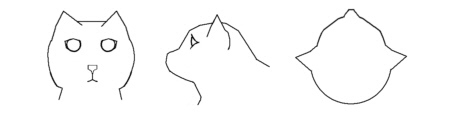
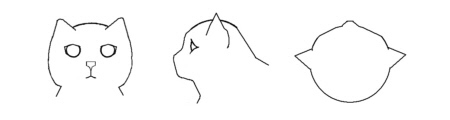
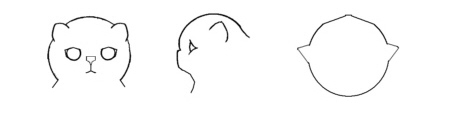
There are three different "qualities" of kittens - doll faced, moderate, and extreme. Silver and Golden Persians are somewhat different in appearance than other colors of Persians due to the differing length of time the colors have been worked with in an effort to improve type and more fully meet the CFA Persian Standard. And although there are many things to take into consideration, below is a chart that shows the main differences in head-type with doll faced, moderate, and extreme cats.
Doll Face
The head of a doll face kitten is wedge shaped. The cheeks are angled and shallow as opposed to being full and round. The ears are large, pointed, and set close together, high on the head. The nose has little or no break and the top of the nose leather is well below the bottom of the eyes.
A few of my kittens look like this, but not very many.
Moderate
The head of a moderate typed kitten is round, the cheeks are slightly rounded, the ears are small to average in size and may be set slightly high on the head. The nose has a definite break and the top of the nose leather is at or slightly below the bottom of the eyes.
Most of my kittens look like this. They are sold as pets and breeders with many being good enough to be shown and be moderately competitive having no disqualifying faults.
Extreme
The head of an extreme kitten is usually more round than moderate or doll faced kittens when viewed from all directions. The cheeks are fuller and rounder, and the ears are smaller, rounded, and set low as to not interfere with the overall roundness of the head. The nose has a deep break and the top of the nose leather is above the bottom of the eyes.
A few of my kittens look like this, but not very many. They are mostly sold as breeders and show kittens but occasionally as pets if they have a small flaw that would keep them from being shown competitively.
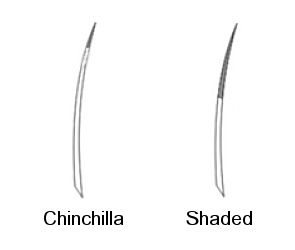
Chinchilla vs Shaded
There are two classifications of Silvers: Chinchilla and Shaded - this describes the length of the tipping on the guard hairs. The base color of the hair shaft in Silvers is white with black tipping. Chinchillas have very little tipping which makes them appear to be nearly pure white whereas Shadeds have slightly heavier tipping which gives them the radiant look of shimmering silver. Goldens have the same Chinchilla and Shaded classifications. The base color of the Golden's hair shaft is a warm honey color with black tipping. In the case of Chinchilla and Shaded Blue Goldens and Blue Silvers, the tipping is blue.
Hand Delivery:Pet transporters are available for hand delivery airport to airport. We will help you find someone that best suits your needs. The current cost as of October 2021 is around $600 for a transporter.
Cargo shipping: Due to the new Federal Department of Agriculture regulations, Persians can no longer be shipped via cargo - this means you will have to either drive to my home to pick up your kitten or fly into the Atlanta airport where we will meet you so you can carry your kitten home in the cabin on your return flight home. You will have to contact the airline of your choice to get up to date information and pricing and all reservations and accommodations for the flight will be made by you. If the kitten is required to have a health certificate for a registered veterinarian, there will be an additional $100 fee for us to get the examination and paperwork in order for you. Although we will do our best to accommodate your specific needs, due to local traffic concerns, travel time, airport security and check-in requirements, your reservation will have to be made according to our personal schedule. We will work with you on scheduling.
~ Taking Your New Kitten Home ~
Congratulations on getting a new kitten! I hope you have many years or fun and companionship together. Remember, this is the first time your kitten has been away from the only home it has ever known. It will be without its mother, littermates, familiar surroundings, and people for the very first time and this can be a frightening experience. This document is to help you help your kitten adjust to its new home quickly and assure its health if you will but follow a few simple guidelines.
When you pick up your kitten from my home, bring a clean, sturdy, carrier for it to go home in. This will make the kitten feel safe and secure while going for its first car ride. No soft-sided carriers are allowed for picking up your kitten – only hard plastic. If you show up with a soft-sided carrier, you will have to go to Walmart and get a hard plastic one before I will allow you take your kitten home.
Under no circumstances should you take the kitten out of its carrier while in the car. A kitten that gets loose in the car can get seriously hurt, killed, or cause an accident.
Once you arrive home, set the carrier with the kitten still inside, on a table or kitchen counter top in your home for at least 30 minutes. Try to keep the house quiet as the kitten adjusts. This will give the kitten a chance to get its bearings by picking up on the scent of your home, as well as the scent of the people and other pets in the environment.
If you have other pets, after the 30 minute elevated adjustment period, set the carrier on the floor and walk into another room. While keeping a watchful eye on the situation, let the other pets in your family "discover" the new kitten. If "words" are exchanged, let them say whatever they want without your intervention but do not let it develop into something that scares the kitten. An older cat hissing at your kitten is perfectly fine. Do not punish or scold the older cat; just let it say whatever is on its mind.
After about 30 minutes, most already established pets will loose interest in the newcomer and walk way or lay down nearby. This is what you want to happen and can be a sign of acceptance.
If you have a spare room without furniture the kitten can hide under or a bathroom that can serve as temporary quarters for your new kitten, take it there and show it the litter box, food and water dishes. Keeping your kitten in a small space will make it feel safe and allow it adjust to its new home and family much quicker. Keep the door closed at all times but visit your kitten frequently to reassure him that you’re nearby. You might want to announce yourself before you open the door by saying something in a calm voice.
Your kitten will let you know when it's ready to meet the rest of the world by asking to be let out of the isolation room. Often, when ready to move into the rest of the house, a kitten will stick its feet under the door and want to play with whoever or whatever is on the other side of the door. Sometimes it takes a week, sometimes only an hour; let the kitten decide when it’s ready to venture into the rest of the house.
Kittens/cats are free-fed; meaning they should have food available at all times. Cats will rarely over eat and are considered "snackers" since they eat many small meals throughout the day and during the night.
It's normal for a new kitten to not eat for one or two days but have food available anyway. Your kitten has been eating Iams Kitten dry food so keep him on that food for at least 8 months. If you decide to switch to another brand of kitten food, do so slowly and over a period of about 6 weeks to avoid any digestive upset.
Keep your kitten inside at all times. Kittens act differently than puppies and will not come to you if called; if it gets outside, it will bolt and hide.
Do not let your kitten have cow's milk; it can make them severely ill and cause diarrhea. If you want to give your kitten milk as a treat, the only milk to be offered is Goat Milk and it should be purchased from a grocery store to insure purity and freshness. Condensed Goat Milk is a great way to offer this treat: mix one can of condensed Goat Milk with one can (or more as desired) of water; refrigerate in an air tight container to maintain freshness – it will last for several weeks if stored properly. You can also pour it into ice cube trays and freeze it, allowing a cube to melt before offering as a treat. Condensed Goat Milk can be found in most major grocery stores along side of other baking essentials such as flour and sugar.
Canned cat food can cause digestive upsets and diarrhea so be careful if you choose to feed canned food – even if only occasionally. Gerber pure meat baby foods are great treat but are not nutritionally complete so they should only be feed as a special treat or if you ever need to hide medication in food. Gerber baby food will not cause digestive upset.
Scoop the litter box every day and clean and disinfect the box once a month or more frequently if needed and refill with fresh litter. Clorox Clean-up is good to use for monthly cleanings or a 10% diluted solution of regular Clorox bleach and water. If you dilute Clorox you must remember that it begins to lose its disinfecting properties as soon as it is mixed with water - it will no longer disinfect anything after a few hours of being diluted. You might want to consider rotating Clorox and a 10% diluted solution of ammonia for disinfecting - but never use them at the same time; this will create a poisonous gas that is harmful to your (and kitty's) respiratory system. Disinfecting with a 10% ammonia solution, for instance, is the only way to kill coccidia so it’s worth using every now and then to make sure you are covering a broad range of bacteria, viruses, and parasites when you clean. When disinfecting the litter box, wipe it out with paper towels and immediately throw them away to dispose of the collected bacteria, etc.
Never let your kitten or cat eat dog food. And if you have a dog, you should put the kitten/cat food somewhere that the dog cannot eat it – some people will put it on a cat tree or in the bathtub (this can also a good place for the litter box to keep dogs out of it but not if you keep the food in the bathtub also). Most dog food is higher in grain content which can cause severe diarrhea or a prolapsed anus in cats. Dog food is not nutritionally balanced for cats since cats are true carnivores and cannot digest plant proteins.
Always keep the food and water bowls far away from the litter box to avoid contamination from scattered litter and litter dust.
Never use essential oils on your kitten/cat or in your home. ALL essential oils are considered toxic to cats even if used as aroma therapy and in scented candles and potpourri. Although they are safe for dogs, they are toxic to cats. Never use a shampoo with essential oils on your kitten/cat – especially tea tree oil and citronella which are in many shampoos.
Never use dog products or over-the-counter human products on your kitten/cat without consulting with your vet or the product's manufacturer beforehand.
Keep your kitten's/cat's nails trimmed. Your kitten comes to you already used to this so keep up with the practice every month and it will always be an easy task. Properly trimmed nails will not harm your furniture, clothing, or skin.
Do not declaw your kitten/cat. This procedure is the equivalent of cutting off the your children's fingers at the first knuckle. Declawed cats are not allowed to be shown in CFA sponsored shows. Many vets refuse to declaw cats and some cities are now outlawing this cruel surgery.
Comb your kitten every day or so whether it needs it or not. This keeps them used to grooming and is a great way to bond with your new pet.
Slight tear staining is common for Persians. As long as there is not puss in the eye or redness under the lid, there is no need for worry. Sometimes tearing is caused by seasonal allergies like with people - blooming ragweed in March and September are common causes of tearing and eye infections. If the tears oxidize on the coat, they will turn a reddish brown color. This is normal and not to be a concern in most cases. Wiping around the eyes with a clean, warm, damp cloth will remove any tearing and prevent staining. Kitty should have its own set of wash cloths and towels for cleaning and bathing. Baby shampoo is safe to use on cat faces and will not cause irritation to the eyes. Baby shampoo will however, make a cat’s coat look terrible so limit its use to the face.
Spay or neuter your kitten at the time your vet recommends. This is normally between the 6 and 9 months of age.